· TradeGym Editorial Team · Market Structure · 12 min read
SEBI Closing Auction Session: What Changes at 3:15 PM, 3:35 PM and 3:40 PM
SEBI's Closing Auction Session changes how F&O-linked stock closing prices are discovered. Understand the timeline, order rules and trader checklist.
If you trade F&O stocks, the last part of the trading day has changed.
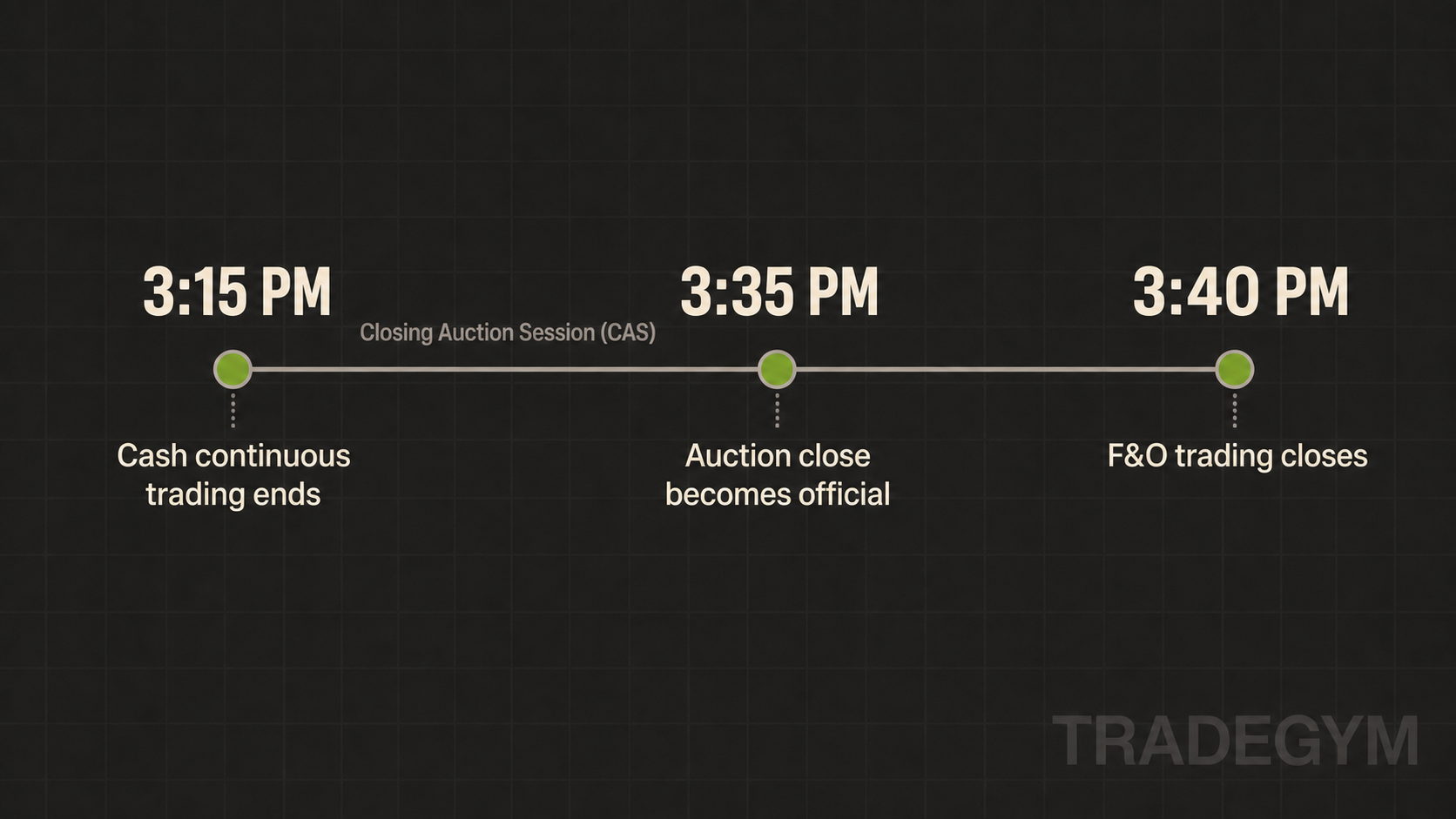
From 3:15 PM onwards, an eligible stock is no longer trading in the usual continuous way. Instead, its closing price is discovered through a Closing Auction Session (CAS). That auction ends with one final closing price at 3:35 PM. Equity derivatives, meanwhile, continue trading until 3:40 PM.
That may sound like a small timing change. It is not. The official closing price affects derivative settlement, index calculations, mutual-fund NAVs and the way traders read the final candles of the day.
This guide explains the new SEBI Closing Auction Session in plain English, what you should watch, and how to avoid treating the last 25 minutes as normal trading.
The one-line version: For stocks with active derivatives, normal cash-market trading ends at 3:15 PM. A closing auction determines the official close by 3:35 PM. F&O trading continues until 3:40 PM. Do not assume the 3:15 PM last traded price is the final close.
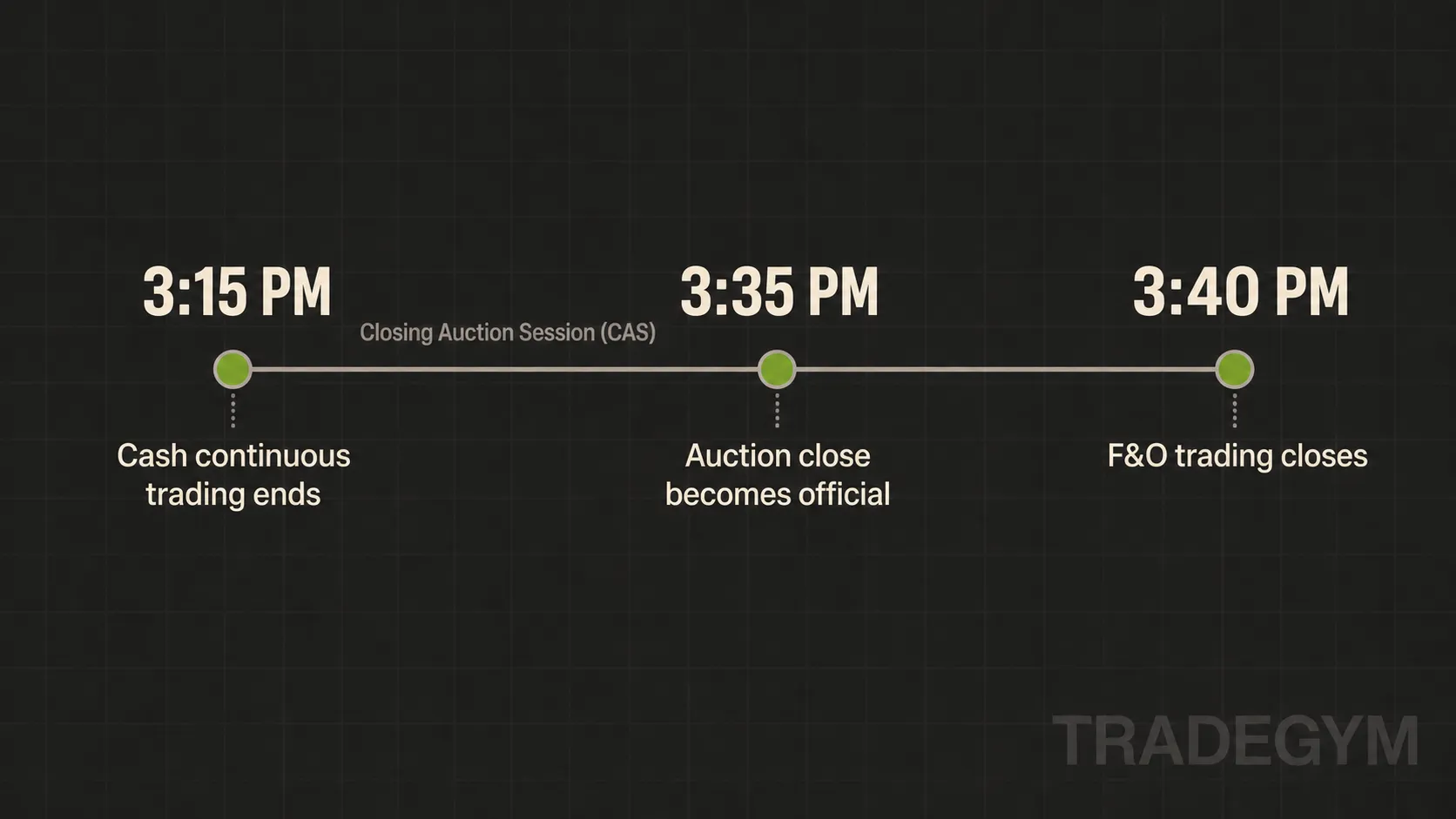
The new close has three distinct moments. The subtle TradeGym watermark identifies this as original educational content.
First, a quick correction: this is not a new 3:40 PM settlement
People may casually call this the 3:40 PM settlement change, but that phrase blurs three different things:
- 3:15 PM: Continuous cash-market trading stops for CAS-eligible shares.
- 3:35 PM: The closing auction finishes and the official cash closing price is determined.
- 3:40 PM: Equity derivatives trading closes.
The 3:40 PM time is the extended trading close for equity derivatives. It is not a promise of a safe last-five-minute trade, and it does not mean every stock trades in the auction.
Why SEBI changed the closing-price process
Earlier, the closing price of a cash-market stock was generally based on the volume-weighted average price (VWAP) of trades in the final 30 minutes. VWAP is simply an average that gives more weight to prices where more shares traded.
SEBI has introduced CAS first for cash-market securities that have derivative contracts. The aim is to gather buy and sell interest into one auction, then find the price at which the most quantity can trade. SEBI says this can provide a fairer, more transparent closing price and help large orders execute more efficiently. Closing prices matter because they are used in areas such as derivative settlement, index computation and mutual-fund NAV calculation.
Think of it like this. Instead of hundreds of small, time-spread trades deciding the close, the exchange briefly collects orders in one room and clears the room at one price.
For a trader, the important lesson is simple: the close is now an event, not just the last tick.
Which shares are affected?
CAS is being introduced in phases. In the first phase, it applies to cash-market securities on which derivative contracts are available. Other cash-market securities continue with the existing VWAP-based closing-price method for now.
Do not guess from a company’s size or index membership. Check your broker’s contract/security information or the exchange’s CAS identifier. A stock can also cease to be CAS-eligible if it is removed from the derivative segment across exchanges.
The new NSE cash-and-F&O timeline, in plain English
| Time | What happens | What it means for you |
|---|---|---|
| 9:15 AM-3:15 PM | Normal continuous trading in CAS-eligible cash shares | This is the regular part of the day. |
| 3:15 PM-3:20 PM | Transition and reference-price calculation | You cannot place fresh orders for the CAS-eligible cash share in this window. The exchange calculates a reference price and revises the CAS price band. |
| 3:20 PM-3:25 PM | Auction order entry for market and limit orders | The exchange shows indicative auction information. Execution is not guaranteed. |
| 3:25 PM-random close between 3:28 PM and 3:30 PM | Limit-order phase | Limit orders can still be placed, modified or cancelled; market orders cannot be modified or cancelled. |
| Around 3:30 PM-3:35 PM | Matching and closing-price calculation | The exchange matches eligible orders at a single equilibrium price. |
| 3:35 PM-3:40 PM | Equity derivatives continue trading | F&O traders can react to the now-known cash close, but prices and liquidity can move quickly. |
Cash securities that are not CAS-eligible continue in the normal continuous session until 3:30 PM. The cash-market post-close session runs from 3:50 PM to 4:00 PM at the closing price.
How does the auction decide the final price?
The exchange does not pick the last traded price. It uses an order-matching process to find an equilibrium price: the price where the largest possible quantity can be matched between buyers and sellers.
If more than one price can match the same maximum quantity, the exchange applies tie-breakers, including the smallest remaining imbalance and closeness to the reference price. In short: the matching engine is trying to find the cleanest single clearing price from the orders that actually arrived.
That is why a 3:15 PM chart price and a 3:35 PM official close can differ. It is not automatically an error. The two figures answer different questions:
- The 3:15 PM price is the final trade from the continuous cash session.
- The 3:35 PM price is the result of the closing auction.
What can retail traders actually do with this information?
The useful response is not to chase every late move. It is to improve your process.
1. Stop planning cash-share exits at the last minute
If you are trading a CAS-eligible share intraday, your normal cash-market exit window effectively ends at 3:15 PM, not 3:30 PM. Broker auto-square-off cut-offs can be earlier and vary by broker and product type. Check your broker’s current policy rather than relying on a social-media screenshot.
Practical habit: Put a cash exit check in your plan before 3:10 PM for any leveraged intraday stock position.
2. Separate indicative from final in your mind
During the auction, the exchange can disseminate an Indicative Equilibrium Price (IEP), indicative buy and sell quantities, and imbalance data. Those are useful signals about the current auction book, not a guaranteed closing price. Orders may change until the random close.
Practical habit: Treat the IEP as a dashboard reading, not a target. If your broker does not show it clearly, do not fill the gap with assumptions.
3. Re-check F&O risk after 3:35 PM
The cash closing price is known after the auction, while index and stock derivatives still trade until 3:40 PM. That can create fast repricing in futures and options, especially around expiry or in heavily traded names.
Practical habit: If you carry options overnight, know your maximum loss and margin buffer before 3:35 PM. Avoid making an impulsive adjustment just because the screen moves sharply in the final minutes.
4. Fix your chart-reading routine
Some platforms may display the transition differently. A chart can show the last continuous-session trade at 3:15 PM while the official close is discovered later in the auction. If a closing candle looks unusual, verify the official exchange close before changing a strategy because of a mystery candle.
Practical habit: For end-of-day review, record both the 3:15 PM continuous price and the 3:35 PM auction close where the difference affected your setup.
5. Practise the end-of-day sequence before using real money
This change is mostly about execution discipline, not finding a shortcut. Traders who have only watched the old 3:00 PM-3:30 PM rhythm need repetitions in the new one: position check, order rules, auction information, final close, F&O reaction, review.
In TradeGym, replay an end-of-day session and write down your decision before the final price is known. Then review what changed once the close became available. The goal is not to predict the auction. The goal is to make your decisions less reactive.
Important order-rule details
These rules matter more than most people expect:
- No order entry is allowed in the 3:15 PM-3:20 PM transition for CAS-eligible cash securities.
- From 3:20 PM-3:25 PM, market and limit orders are allowed.
- From 3:25 PM until the random close, only limit-order changes are allowed; market orders cannot be changed or cancelled.
- The random close can occur any time from 3:28 PM to 3:30 PM. Changing an order at the last second is not a reliable plan.
- Exchange-supported Market-on-Close (MOC) and Limit-on-Close (LOC) order types are not available on NSE’s CAS FAQ.
- Not every order from continuous trading carries forward. For example, special orders and orders outside the revised CAS price band may be cancelled. Unexecuted eligible limit orders can carry forward, with the time-priority rules set by the exchange.
This is why the last few minutes deserve a pre-written plan. The auction is designed to be orderly, but it is not designed to make rushed execution easy.
What traders and brokers are saying about CAS
The reaction has been more nuanced than simply “good” or “bad.”
Nithin Kamath, Zerodha’s co-founder and CEO, called the change more complicated. His point was two-sided: a pooled closing auction can make it harder for a large late order to influence the close and can help passive funds execute closer to the benchmark. But three different end times - 3:15 PM, 3:30 PM and 3:40 PM - also create a real education problem for brokers and clients. He said Zerodha expected the change could reduce brokerage income by roughly 1% to 5%.
Retail reactions have focused less on the theory and more on the screen in front of them. In comments on Zerodha’s CAS explainer, traders asked three practical questions:
- Why did a stock or index appear to move sharply between the end of continuous cash trading and the official close?
- Where can I see the indicative auction price and order imbalance before the auction ends?
- How should I manage an option or futures position while the cash market is no longer trading continuously?
Those are fair questions. They do not prove that the auction is flawed, but they show where the learning curve is: understanding the difference between a continuous-session price, an indicative auction price and the final closing price.
For TradeGym users, that is exactly the drill. Do not just study the rule. Replay the close, write down what information you had at 3:15 PM, then compare it with the auction result and the F&O price at 3:40 PM. Good risk management begins when you can explain what changed, not when you can react the fastest.
What this does not mean
It does not mean there is a guaranteed or risk-free cash-futures arbitrage between 3:35 PM and 3:40 PM. Trading still involves execution risk, liquidity risk, transaction costs, margin requirements, contract-specific settlement rules and the possibility that you cannot enter or exit where you expect. A visible price gap is not the same as a usable trade.
It also does not mean the closing auction applies to every listed share today, or that your broker’s intraday square-off policy has become universal.
The better question is: Does my plan still make sense when the official close is discovered differently?
A simple five-point checklist for every F&O trader
Before the final 30 minutes, ask:
- Is the underlying share CAS-eligible?
- If I hold cash intraday, when does my broker require me to close it?
- What orders could be cancelled or become hard to change after 3:25 PM?
- What happens to my futures/options risk if the auction close differs from the 3:15 PM price?
- Am I reacting to a final exchange price, or only an indicative number?
If you cannot answer these calmly, reduce complexity. A smaller, clearly understood position is better training than a clever trade you cannot manage.
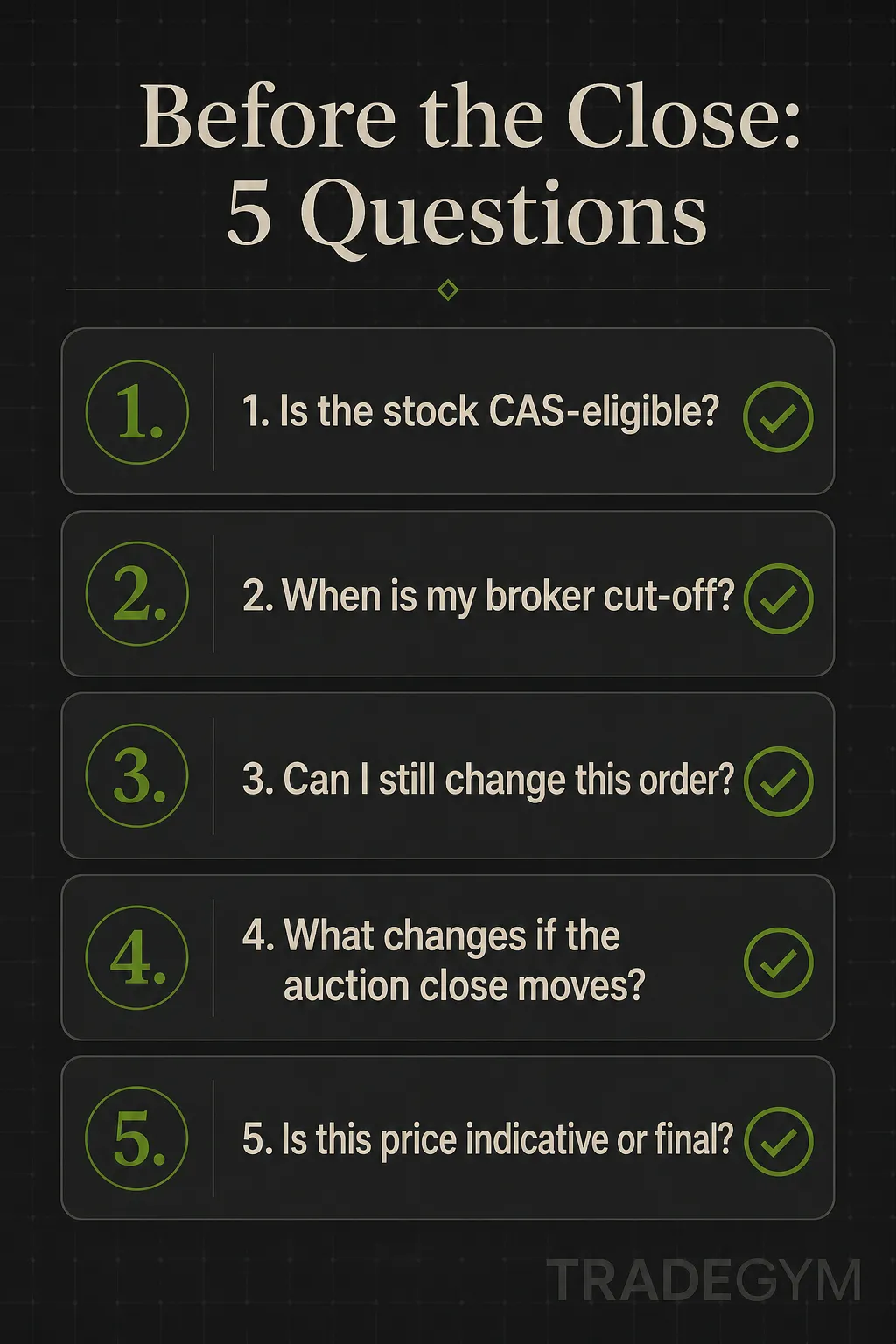
Save this checklist for your end-of-day routine. It is a process prompt, not a trading signal.
The bigger takeaway
SEBI’s Closing Auction Session changes the plumbing of the market, but it also changes the habits that sensible traders need at the close. The final 25 minutes now have distinct phases, different order rules and a separate moment when the official cash close becomes known.
For most retail traders, the edge is not speed. It is preparation: knowing which session you are in, knowing what your order can and cannot do, and reviewing how a late close affected your risk.
That is a skill you can practise.
Train before you trade. Use market replay to rehearse the new closing sequence, test your end-of-day rules, and review the decisions that mattered before the next live session.
Frequently asked questions
What is SEBI’s Closing Auction Session (CAS)?
CAS is a separate 20-minute session used to determine the official closing price for initially eligible F&O-linked cash-market shares. It runs from 3:15 PM to 3:35 PM, with orders collected and matched at a single equilibrium price.
Does the stock market now close at 3:40 PM?
For CAS-eligible cash shares, continuous trading ends at 3:15 PM and the closing auction completes by 3:35 PM. Equity derivatives trade until 3:40 PM. Non-CAS cash securities continue their normal continuous session until 3:30 PM.
Can I place an order during the Closing Auction Session?
Yes, subject to the phase-specific rules. There is no order entry from 3:15 PM to 3:20 PM. Both market and limit orders are allowed from 3:20 PM to 3:25 PM. In the later limit-order phase, market orders cannot be modified or cancelled.
Is the Indicative Equilibrium Price the final closing price?
No. It is an indicative figure based on the current order book. The final price is determined after the auction closes and matching is completed.
Is the 3:35 PM-3:40 PM F&O window a guaranteed arbitrage opportunity?
No. It can involve fast repricing, but no public trading window is risk-free. Execution, liquidity, costs, margins and contract rules all matter.
Sources and further reading
- SEBI circular: Introduction of Closing Auction Session in the Equity Cash Segment
- NSE FAQ: Closing Auction Session in the equity segment and changes in equity derivatives
- NSE Clearing circular: Risk management for CAS
- Nithin Kamath’s July 28, 2026 post on X
- Zerodha’s CAS explainer and reader discussion
Educational content only. This article is not investment advice, a trading recommendation, or a promise of results. Exchange rules and broker policies can change; verify the current rules with your broker and the relevant exchange before trading.